
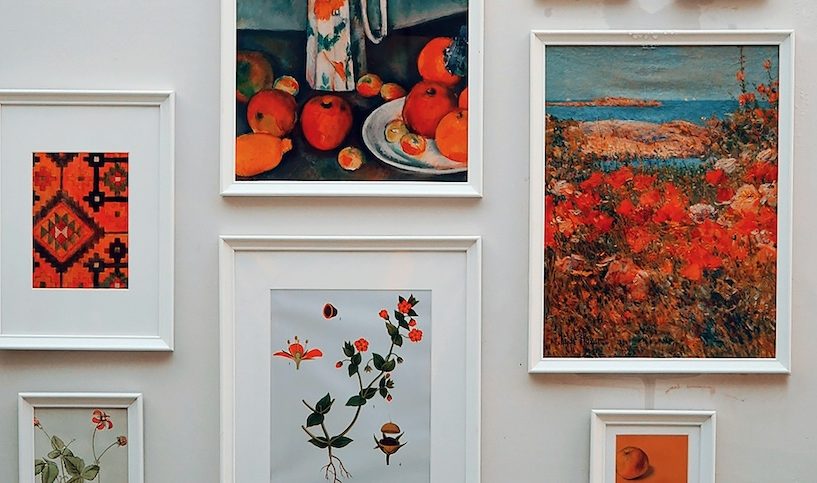
A blank wall is an invitation, not a challenge. With a few simple rules, you can turn prints, photos, and mementos into a collected, confident gallery that feels like you. Think in three steps: source with a theme, frame for cohesion, and hang with consistent spacing.
SOURCE: START WITH A SMALL STORY
Pick a tight theme so mixed pieces feel intentional. Options: “travel doors,” “black-and-white portraits,” “botanical line drawings,” or “family moments in soft color.” Aim for 5 to 9 pieces: enough variety without chaos. Combine scales—one larger “anchor” (A2 or 50×70 cm), a couple mediums (A3 or 30×40 cm), and smaller accents (A4/13×18 cm). Mix mediums (photo, print, textile, postcard), but keep a unifying thread like a shared palette or subject.
FRAME: COHESION OVER MATCHING
You don’t need identical frames; you need harmony. Choose one of these easy formulas:
- Single color frames, mixed sizes (all black or all light wood).
- Two tones max (e.g., oak + white).
- Mat boards create breathing room and raise perceived value—use a mat on the anchor piece and echo it on one or two others.
Pro tip: anti-glare glass helps in bright rooms. If art is precious, keep it out of direct sun.
HANG: THE RULES THAT MAKE IT LOOK “RIGHT”
- Eye-line rule: target a 145 cm centerline (measured from floor to the artwork’s center). This suits most heights and keeps rooms consistent.
- Spacing rule: keep 5 to 7 cm gaps between frames in a gallery grid; go 7 to 10 cm for looser, organic layouts. Consistency matters more than the exact number.
- Edge rule: align at least one clean edge (top, bottom, or side) across several frames to calm the composition.
- Balance rule: place your largest, darkest, or most visually heavy piece slightly off-center, then “counterweight” with two or three lighter pieces.
PLAN BEFORE NAILS
Lay everything on the floor first. Shuffle until it feels balanced. Trace frames onto kraft paper, cut the templates, and tape them to the wall at your target heights and gaps. Stand back, adjust, then mark the hanging points on the paper. For rental-friendly hanging, use quality adhesive hooks rated above your frame weight; for heavier pieces, use wall plugs or screws.
HARDWARE & LEVEL
Use sawtooth or D-rings for small frames; wire + two hooks for larger frames to prevent tilt. Measure twice. Use a bubble level (or your phone’s level tool) and a tape measure. If frames slowly skew over weeks, add a tiny removable wall bumper at the bottom corners to keep them straight.
LIGHTING & GLARE
If possible, place the wall opposite a window rather than perpendicular to it to reduce glare. Add a warm white picture light or an adjustable track spotlight for the anchor piece. Aim lights at 30 degrees from vertical to minimize reflections.
MAINTENANCE
Dust frames monthly with a dry microfiber cloth. Swap one piece seasonally to keep the wall feeling alive without rebuilding the whole layout.
TRY IT TODAY
Pick a theme, gather 5–7 pieces, and choose one frame tone. Tape paper templates, lock in 7 cm gaps, and hang from the center outward. Your blank wall becomes a story wall—personal, tidy, and confidently curated.
Photo by Rendy Novantino on Unsplash.