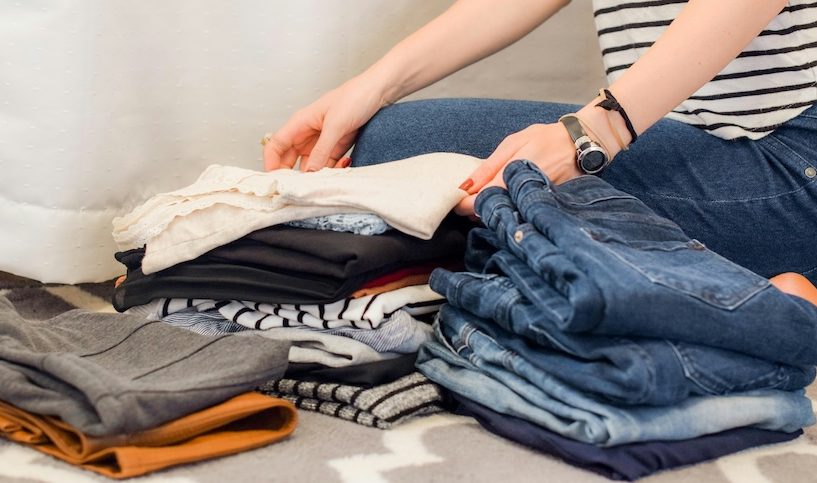
Closets are often treated as practical spaces, but they are also emotional archives. Long before we articulate a life shift, it tends to show up in what we wear, what we stop wearing, and what we keep “just in case.” A wardrobe is rarely just about clothes. It is about identity, transition, and the version of ourselves we are holding onto or learning to become.
Many people recognize the feeling of standing in front of a full closet with “nothing to wear.” The problem is often not a lack of options, but a mismatch between who we are now and what our clothes were chosen for. Life stages change faster than wardrobes, and that gap can feel quietly unsettling.
Fashion psychologist Shakaila Forbes-Bell, author of Big Dress Energy, has written about how clothing shapes identity. She notes that what we wear influences not only how others perceive us, but how we perceive ourselves. When life changes, clothing that once felt right can begin to feel off, even if it still fits physically.
Early adulthood wardrobes often prioritize possibility. There are statement pieces, experimental silhouettes, and outfits chosen for imagined futures. Clothing in this stage asks, Who could I be? rather than Who am I now? It reflects exploration, visibility, and a desire to try on identities through style.
As careers stabilize and responsibilities grow, wardrobes tend to shift toward function and reliability. Comfort becomes important, but so does credibility. Pieces are chosen for longevity rather than novelty. This is often when people start investing in quality without consciously naming it as such. The clothes still express personality, but they support daily life rather than compete with it.
Later life stages bring another subtle evolution. Clothing becomes deeply personal and routine-driven. The most worn items are not necessarily the trendiest, but the most trusted. Many people develop a quiet uniform at this stage, not from boredom, but from self-knowledge. Repetition becomes ease.
Closets also hold emotional weight. There are dresses saved for a body that has changed, suits tied to a job that ended, or shoes connected to a past version of life. These pieces are not clutter; they are memory. Letting them go can feel like letting go of a chapter, even when that chapter no longer fits the present.
Organizing expert Marie Kondo popularized the idea of keeping items that “spark joy,” a phrase that resonated because it acknowledged the emotional role objects play. Whether one follows her method or not, the insight remains useful: clothing carries feeling. When an item no longer aligns with how you live, it creates friction every time you encounter it.
A helpful question is not “Is this still fashionable?” but “What version of me bought this?” The answer often reveals a life stage you have outgrown or are still negotiating. This is why closet edits can feel emotional. They are not about trends. They are about permission and closure.
Psychologists have observed that major life transitions often come with symbolic changes, including appearance. After events such as career shifts, parenthood, relocation, or loss, style frequently changes without conscious planning. Clothing becomes a way to express an internal shift before language catches up.
A closet aligned with your current life stage does not mean losing creativity or individuality. It means allowing your wardrobe to serve your life as it is now, not as it once was. When clothes match reality, daily decisions become easier and dressing feels intuitive rather than performative.
The goal is not minimalism or abundance. It is coherence. A wardrobe that reflects how you actually move through your days supports confidence in subtle ways. In the end, your closet is not asking to be perfected. It is asking to be honest.
Photo by Sarah Brown on Unsplash.