
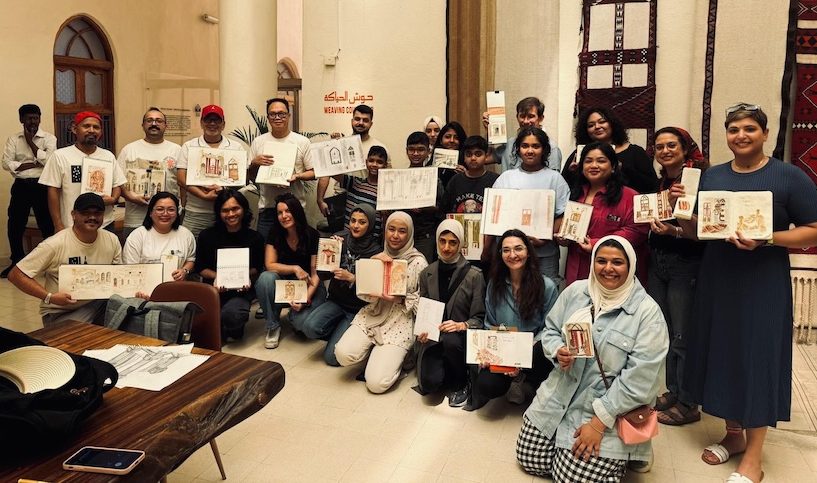
There is a particular kind of stillness that descends when a group of people sit down together to draw. Not silence, exactly. There is still the sound of the city around them, traffic, birds, the distant hum of a coffee machine, but there is an underlying buzz of energy that is almost imperceptible. The pace slows. Eyes move differently, tracing a roofline or the way afternoon light falls across an old stone wall. Hands follow. This is what an Urban Sketchers Kuwait outing looks and feels like, and once you understand it, it becomes difficult to walk past a building in this city without really stopping to look.
Urban Sketchers Kuwait, known as USk Kuwait, is the official Kuwaiti chapter of a global nonprofit community founded in 2007, dedicated to the art of on-location drawing. No working from photographs. No recreating from memory. You draw what is in front of you, as you see it, in the time you have. The result is not just a sketch. It is a record. A specific moment in a specific place, filtered through a specific pair of eyes, uniquely created by human hands. Behind the Kuwait chapter are three women: Dina Dajani, an interior designer and art educator who has been the driving force from the beginning; Moudhi AlYetama, a pediatrician who has kept a semi-daily creative journal for years; and Noura Marafi, a clinical dietitian and certified trainer who arrived as a student and never really left. Together, they are building something that Kuwait did not know it needed.
Dina and Moudhi found each other the way so many creative communities begin today, through Instagram, a shared language of sketchbooks and color. “We both did it separately until we found each other,” Dina recalls, “and started going out together to sketch.” What neither of them knew at the time was that they lived on the same street. Neighbors who had been drawing the same city without knowing the other existed. They later also discovered they are both Capricorns, a coincidence Moudhi notes with evident delight.
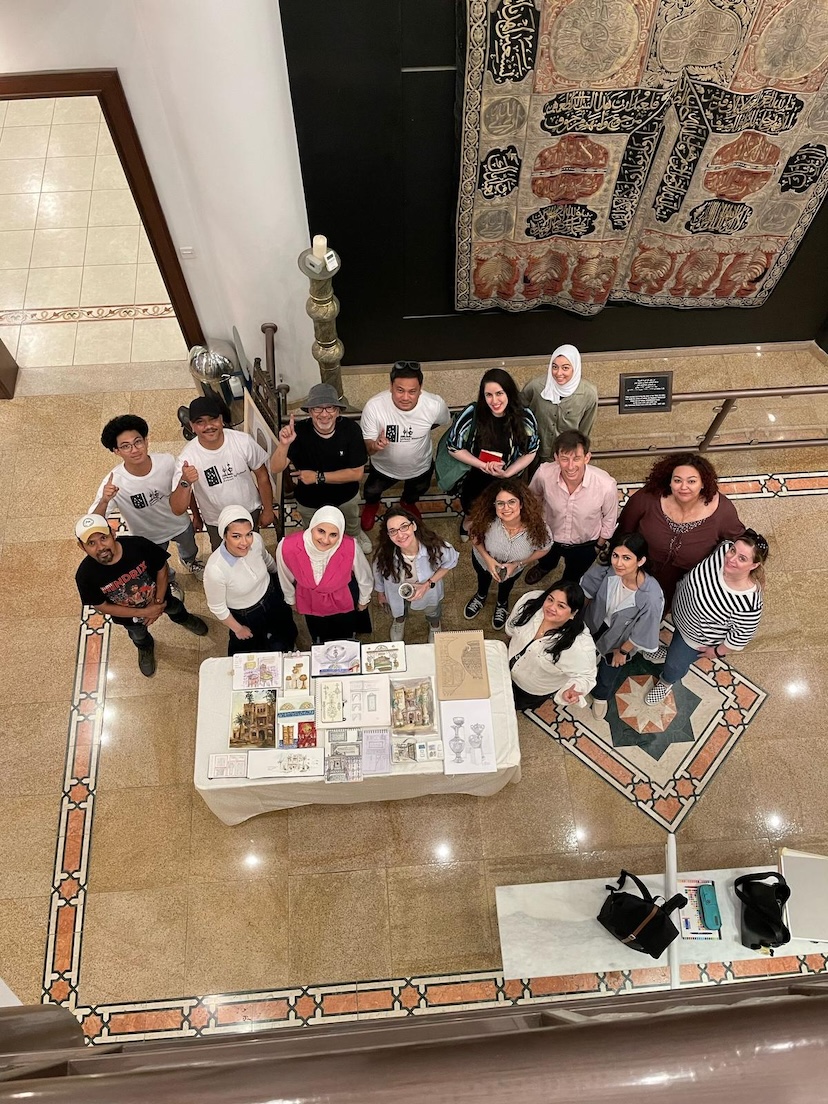
Noura came through one of Dina’s visual journaling workshops. “I always saw myself as bad at art,” she says, “someone who doesn’t know how to sketch, until she showed me that anyone can be an artist.” She attended every course Dina offered, then showed up at a USk outing, and kept showing up. Dina describes her with quiet pride: “She dives straight in and doesn’t fuss too much, and that makes her the best learner. She hasn’t stopped sketching ever since she first started.”
When Dina applied for Kuwait to become a formal global chapter, which it officially became in June 2025, the three of them as a group made instinctive sense. “Having Moudhi and Noura, who are both Kuwaiti, meant that even if I, as an expat, leave one day, they would be here to keep it going.” It is a practical consideration wrapped in something more tender: a community built to outlast any one person’s presence.
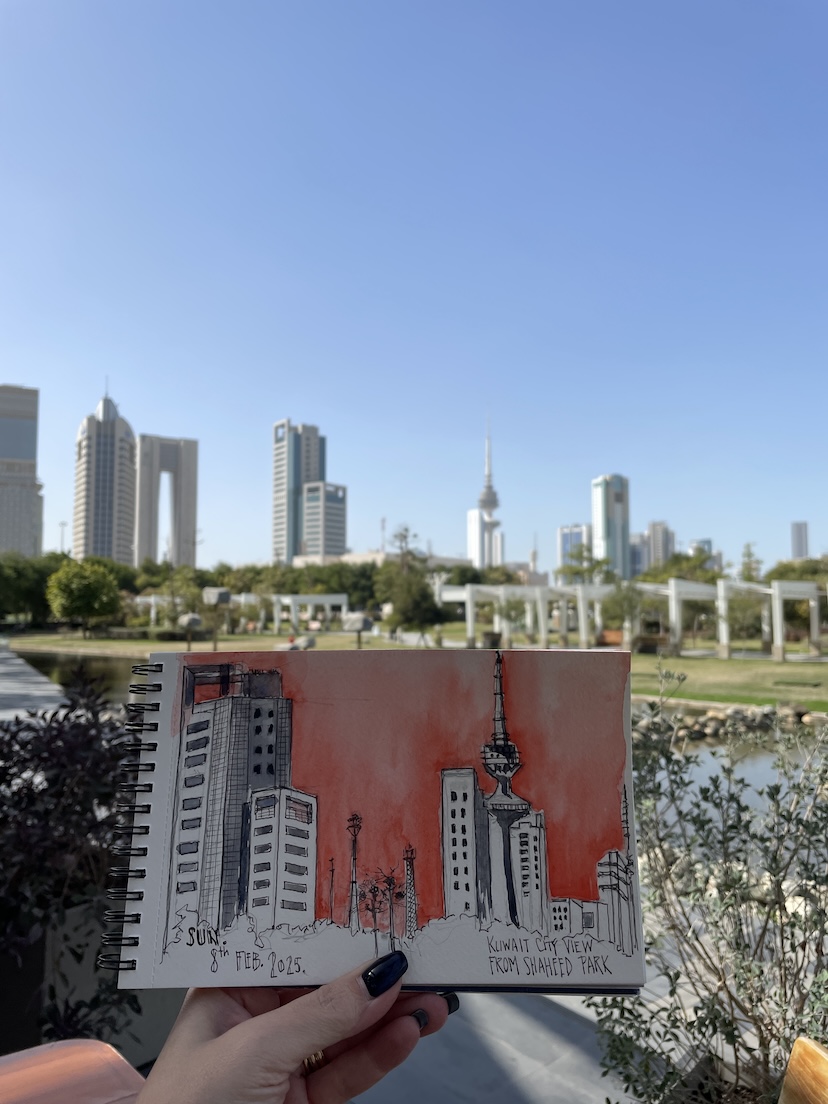
Ask the three of them what Kuwait looks like through a sketchbook and the answers arrive from three different angles, which is perhaps the point. Dina talks about panoramic views of Kuwait City’s skyline, about making compositional decisions, “deleting the details that create too much noise and focusing on framing the focal point.” She describes painting an organic line and ink splashes across a page before the sketch begins, letting the composition breathe before a single building is drawn.
Moudhi sees the city in its layering. “We have a combination of old and historic alongside modern architecture. Old mud houses and mosques adjacent to high-rise buildings.” She is drawn to light: “Sometimes I’m drawn to the way light falls on a building, areas of light and shadow create visual interest.” And she draws people, despite the difficulty of it. “Sketching people is quite challenging since they are a moving subject, but placing a person or an animal in a sketch breathes life into it and creates a narrative, helps to tell the story of the time and place.”
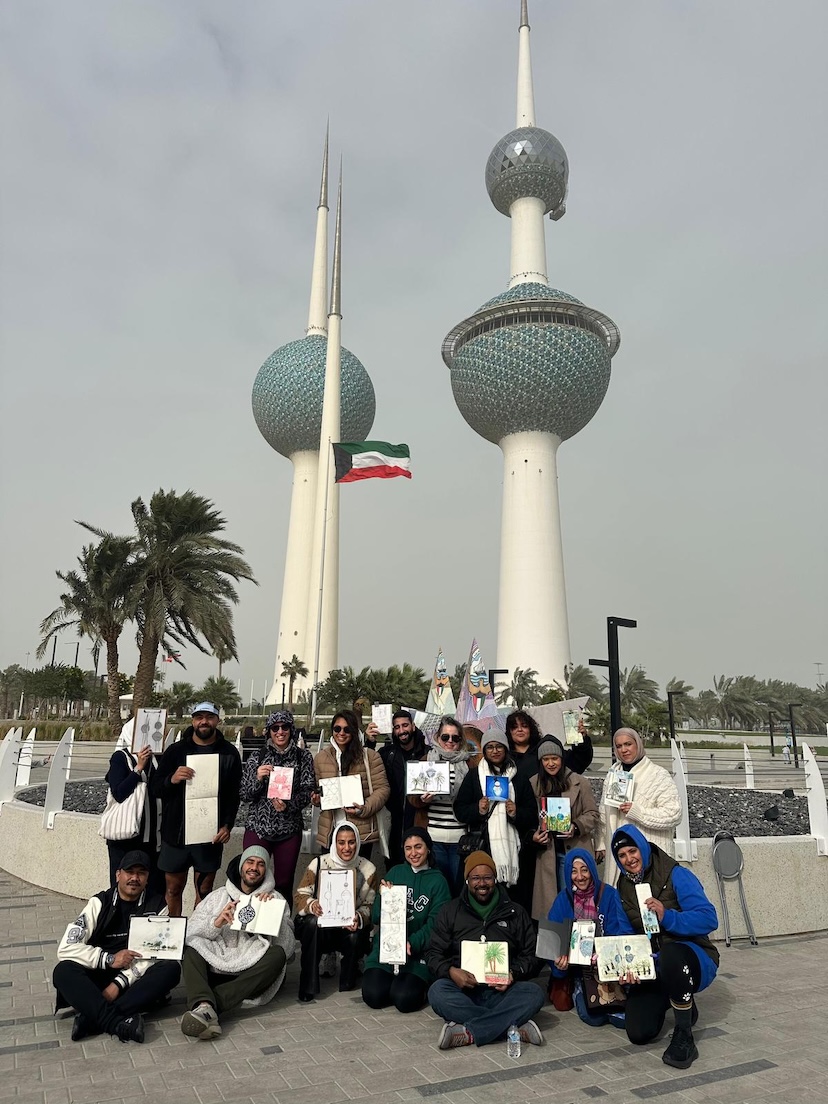
Noura is pulled toward nature, trees, the sea, grass, the sun, and finds herself overwhelmed by too much pattern or architectural detail. Three artists, three Kuwait Cities. The sketchbook does not flatten its subject. It multiplies it.
The community that gathers around them is as varied as their individual approaches. A retired professional finding art for the first time. A school student brought along by a parent. A doctor, a dietitian, a designer. “We are a true mix of all ages, different professions and artistic abilities,” says Dina. What brings them all to the same pavement with a pen is harder to explain, but Moudhi comes closest: “Art allows me to mentally disconnect from everyday demands and go back to the core of my being. You don’t have to have the talent or the skill. It doesn’t have to be a masterpiece. It doesn’t have to be framed or displayed. But it’s something you can do that will bring you tremendous amounts of joy.”
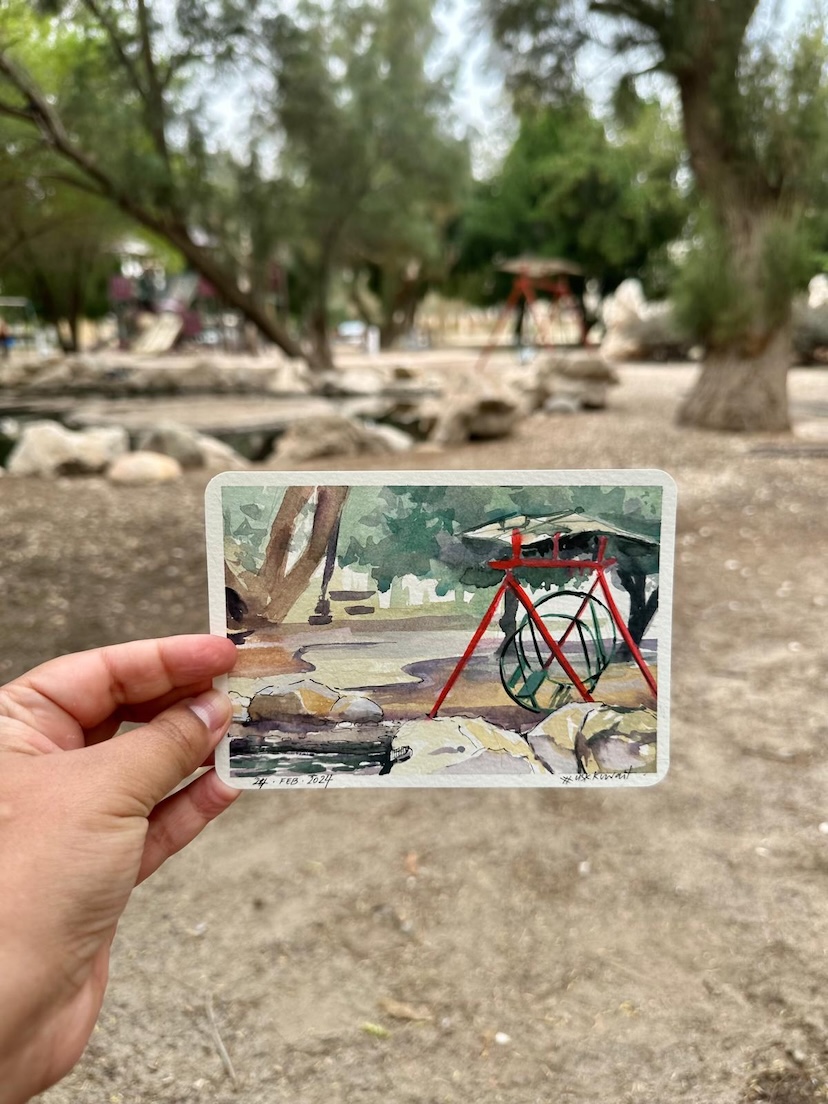
That is, quietly, a radical idea, that art belongs to everyone sitting on a pavement with a sketchpad, not only to those who have earned the right through formal training. It is why USk Kuwait’s meetups are open, and why the admins are warm about nervous newcomers. “If you’re too shy to sketch,” Moudhi says, “come enjoy the atmosphere and see everyone’s sketches. Maybe that will give you the motivation to try.”
Not everything about drawing Kuwait is uncomplicated. The three admins have, on more than one occasion, been approached by security in public spaces and asked to move on. Permissions have been sought and, in some cases, fees requested from a nonprofit group of people spending their weekends drawing. It is an irony not lost on them: a community trying to document the city being moved along by the city itself. Still, they have found willing and welcoming hosts, the Tareq Rajab Museum, the DAI Amricani, coffee shops, the open skies of Kuwait’s winter coastline.
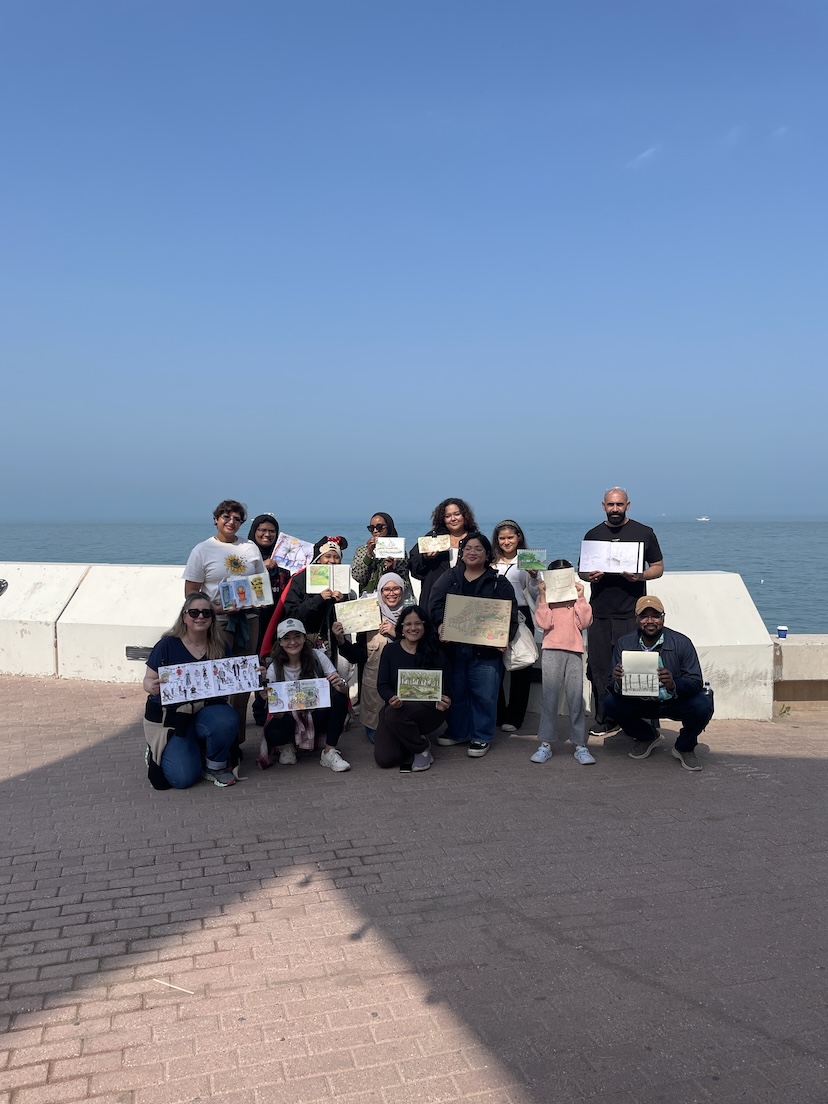
What the camera does not capture is what makes this worth fighting for. “It’s true that a camera would more accurately capture the scene,” Moudhi says, “but that’s not the goal. Sketching is a way to experience life using all your senses. When you sketch a place, you remember the sounds, the smells, the atmosphere.” And then, most precisely: “A part of who you are is reflected into your sketch. The subject you choose, the way you draw your lines, the colors you choose, it tells your story.”
We are all, in some sense, witnesses. To the streets we walk, the buildings we pass without looking up, the city that changes faster than we can immortalize it in our memories or in our camera rolls, let alone feel it. The choice to document that world, slowly, intentionally, with a pen and a sketchbook and the full attention of a human being, is not a small one. What USk Kuwait is building, outing by outing, is an archive that no algorithm will generate and no AI will replicate: Kuwait as its people actually experienced it with their senses, in real time, with their own hands.
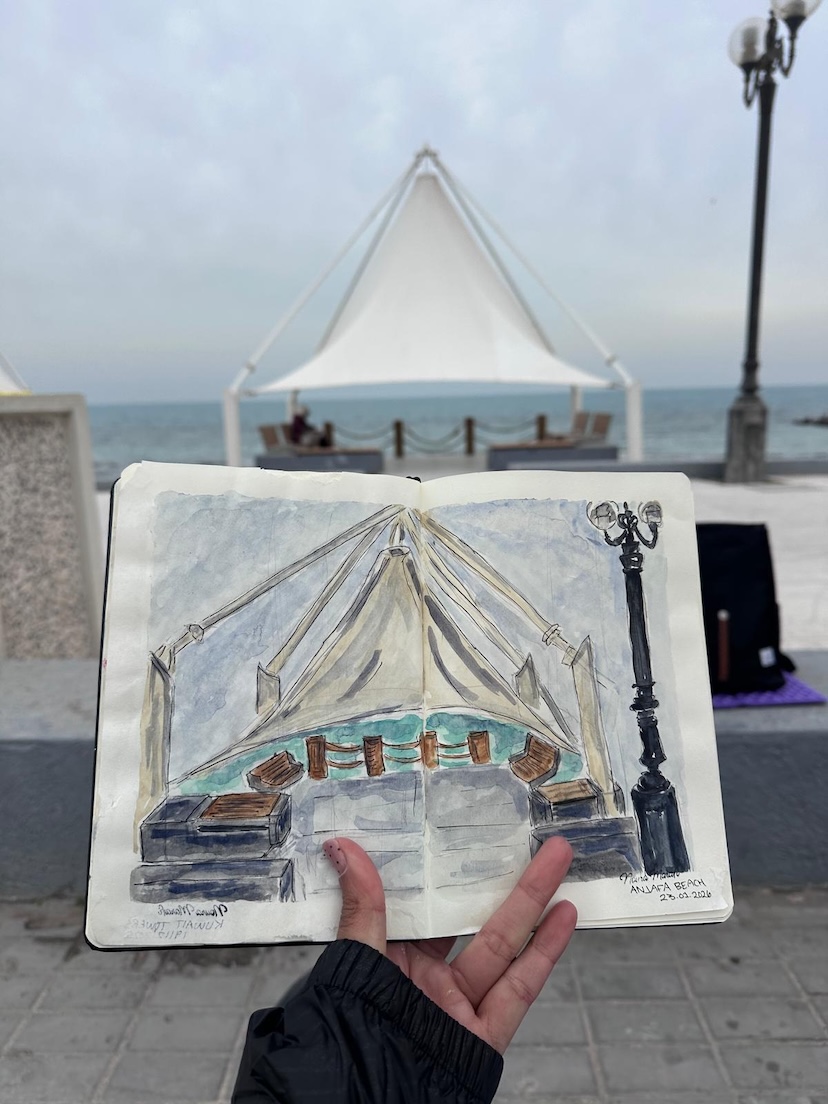
Those sketchbooks may outlast the places they record. They will certainly outlast the moment. And somewhere in them, the next generation will find not just the buildings and the shorelines and the coffee cups, but the people who thought this city was worth sitting down for.
All images are courtesy of Urban Sketchers Kuwait. Use or reproduction without permission is not permitted.
USk Kuwait can be found on Instagram at @urbansketcherskw. You can also follow Dina, Moudhi and Noura’s individual journeys on Instagram @dinadraws__, @moudhipaints and @nouraruns respectively. If you would like to host the USk community and have access to interesting spaces, exhibitions or events please get in touch with them.