
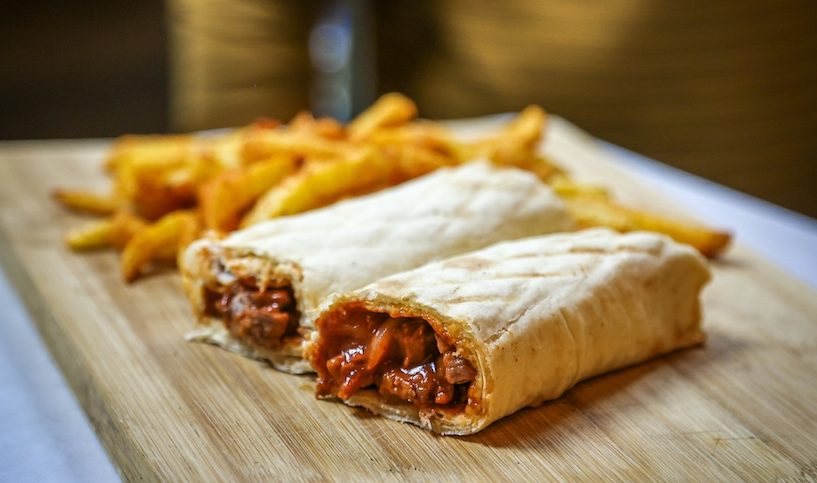
Much has been written about it, and much will be written about it in the centuries to come, yet the mouth-watering stories around the humble Shawarma stay around to entertain us, feed us, and make us nostalgic. Or, in the case of all those who have not relished a Shawarma in Kuwait, deeply envious too. For the sake of English, and out of deep respect for this street food, we’d address the dish with a capital S.
Now, imagine this: a bunch of children crowd around a shop, just by the corner—or rather, every other corner in the city—waiting patiently to get their hands on street food wrapped in a humble paper cover. No brands are stamped across it, and no big billboards announce the corner shop’s name. Many a time, these were nameless shops, yet always easy to find, even in an era without Google Maps, and hugely popular in the pre-Instagram handle-and-hashtag years. The kids have lined up, with adults watching over them, and it is summer (isn’t it mostly in Kuwait!). As sweat trickles down their necks and foreheads outside the shop, the scene inside is ‘hotter’: the meat is on the rotisserie, and the preparation suggests no air-conditioning in this kitchen-cum-shop. The heat is visible to the naked eye, and the aroma of cooking meat is enough to leave anyone nearby hungry and greedy. The meat is constructed, not simply skewered. Thin marinated slices of chicken, beef, or lamb are layered tightly into an inverted cone. The vertical spit turns slowly before the grill, and the shawarma-maker shaves away only the browned exterior with a long knife. The newly exposed surface returns to the heat, creating that essential contrast between crisp edges and juicy meat.
“That’s where it belongs,” laments dear husband, who was born and raised in Kuwait City, which, in short, means no Shawarma other than the ones he had there will ever be good enough—or even come close. We may now live in Dubai, with Michelin-star-worthy Shawarmas within reach, but we don’t have the roadside Shawarma from Salmiya. He and his childhood buddies aren’t against elevating the street-served Shawarma’s status many notches above anything served in seven-star hotels, but they do get upset over the loss of authenticity in ingredients, taste, flavors, preparation methods, and, yes, even the rate card!
Two hundred and fifty fils for a Shawarma and 100 fils for its equally popular vegetarian counterpart, falafel. A single penny more is both a sacrilegious thought and a fact in 2026.
Every other evening, a long day at college or work would end with a stopover at one of the multiple shops; everyone had their favourites, of course. His was Canary. Irrespective of your choice, the Shawarma tasted absolutely the same! There was no science to it, no fusion thrown in and no immersive experience attached. Just basic layering: garlic sauce, a handful of pickles and meat. No wonder his food vocabulary is limited but rich: “A dollop of toum, some pickles and meat; and that’s it.” No Mexican Nutella version to make your eyes gawk in horror, he says of the ones he sees in his current home now.
The bread, too, can define a generation. Today, Shawarma comes wrapped in thin Lebanese or saj bread; older Kuwait-style versions favoured samoon, a soft, elongated or diamond-shaped roll popular in the 1980s. Chicken is typically paired with toum, pickles, and fries, while meat favors tahini, parsley, onion, and tomato. The fries, an extra, absorb the juices and add texture; the pickles cut through the fat, salt and garlic.
So, what is it about this most clichéd item on the menu that ensures its charm never fades, but quite the opposite? It’s the character: unpretentious, affordable, dependable, democratic and deeply nostalgic. It comes from the country’s Palestinian, Lebanese, Syrian and Iraqi culinary influences—and from the way Kuwait’s cafeterias adapted it into a small, inexpensive and highly customizable street snack. Contemporary versions may even carry a touch of maabooj, Kuwait’s chili condiment, giving the Levantine sandwich a recognizably Gulf accent. Shawarma carries a long after-dark history in Kuwait, with restaurants such as Bou Khalil, near Fahd Al-Salem Street, once drawing crowds of young customers and cars.
The bunch of young boys now wear fancier suits, the kitchen hands are wrinkled, and the hair is grey, but neither the wait nor the skill passed down through generations has changed. As I hear stories dipped in memories, I am convinced that when Lorette C. Luzajic wrote the prose poem “The Shawarma King”, she was referring to the shawarma-makers of Kuwait: “He can craft five shawarmas at once.” The skilled performer’s speed, physical movements, and mastery of the preparation process turn an ordinary food counter into a small stage, and the cook’s repetitive labor into something theatrical: the rotating cone, rhythmic carving, spreading of sauce, and rapid wrapping. And if I were to take the liberty of adding to the prose, I’d add, “He can gorge on five shawarmas at once!”—an apt tribute to individuals I now call friends and family.
Purva Grover is a UAE-based author, journalist, and creative entrepreneur. You can stalk her on Instagram, @purvagr.
Photo by Omar Hakeem on Unsplash.