
Noor Alhuneidi does not describe herself the way most founders do. “Honestly, I’m just someone who takes action,” she says. “I don’t come from a tech background, which people find surprising when they hear I’m building a tech company. But I think that’s actually part of why I could.”
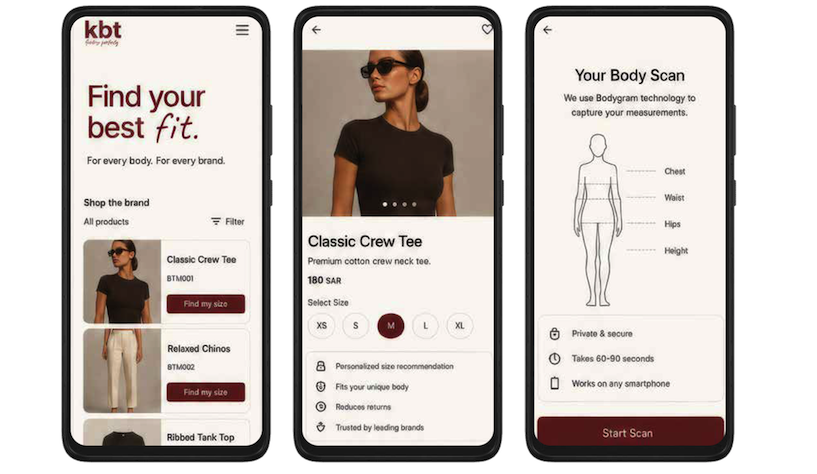
Her company, KBT, is a Gulf-based platform built to solve one of fashion’s quietest frustrations: not knowing whether something will fit until it is too late to do anything about it. The name has nothing to do with acronyms. It comes from كبت, the Arabic word for closet. “Your closet is yours, and everything in it should actually fit you,” Alhuneidi explains. “It shouldn’t be full of things you’re about to return, or things you have to take to a tailor before you can wear them.”
That idea sits behind the company’s guiding line: stop guessing. “Shopping online has always asked you to guess, and we didn’t think that had to be true anymore,” she says.
A Problem Hiding in Plain Sight
The moment that convinced Alhuneidi to build a company came from a packing mishap. She had ordered a batch of clothes ahead of a trip, all in the same size. They arrived only days before she left, some too big, some too small.
“There was no time to return anything, so I just made do with whatever fit,” she recalls. “It wasn’t the disappointment that stuck with me, it was realizing how absurd it was that this is normal. We’ve all just accepted that ordering clothes online is a gamble.” Research followed, then conversations that confirmed it was universal. “It turned out everyone had the same story. That’s when it stopped being a personal annoyance and started being something worth building.”
Wrong sizing is consistently the leading reason clothing gets returned, and returns cost the global fashion industry hundreds of billions of dollars a year. Alhuneidi is candid about why the issue has persisted. “Returns got treated as a cost of doing business rather than a problem to solve,” she says. “You can’t try clothes on through a screen, so everyone accepted the guess and built reverse logistics around it instead.”
She is equally direct about the limits of the standard size chart. “A generic size chart can help, but only to an extent,” she says. “The same person is a medium in one brand, and a large in another, and a chart won’t tell you that. It gives you a label, not the real information.”
Building the Fit Layer
Alhuneidi describes KBT as “the fit layer of fashion.” “We sit between a shopper’s body and a brand’s garment and translate one to the other. Brands keep their own sizing, shoppers keep their own bodies, and we handle the matching in between. It’s infrastructure more than a feature.”
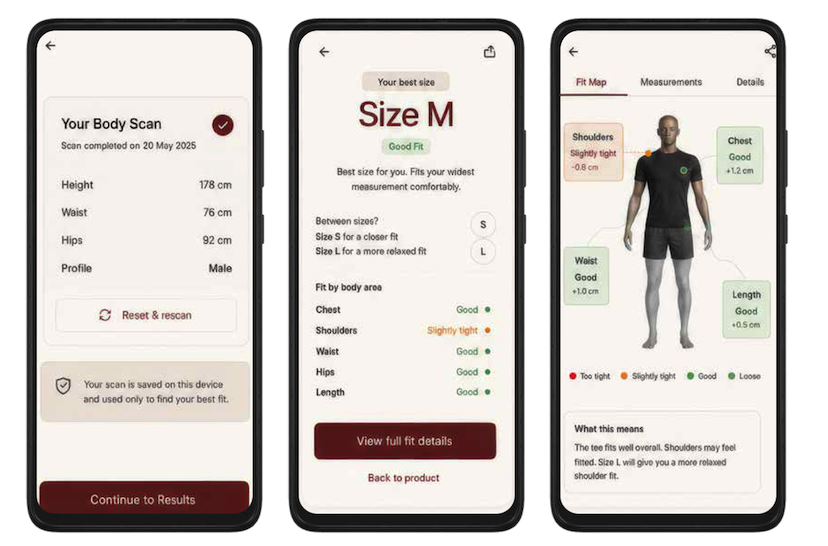
The mechanics follow four steps: a shopper creates a profile and completes a body scan through their phone camera, KBT captures measurements from that scan, those measurements are matched against a brand’s actual sizing for a specific item, and the shopper receives a personalized recommendation, down to where a garment might sit snug or loose and how the length will fall. Alhuneidi is careful to note the privacy built into that process. “The photos aren’t stored, and the data is anonymized. We only keep what’s needed to understand fit, nothing that identifies you.” The scan only happens once. “After that it’s reused across the brand’s items, so it’s a one-time effort, and then it just works.”
The harder problem, she says, is that sizing cannot be converted between brands the way currencies can. “A conversion chart assumes sizes mean the same thing across brands, and they don’t. Two brands can both call something a medium and cut it four centimeters apart. You can’t convert, you have to calibrate, garment by garment.”
Keeping the system precise while easy for retailers to adopt was the defining design challenge. “We deliberately put the heavy work on our side so the brand’s part stays light, because the brands who need this most are often the ones without big engineering teams.” And the system keeps learning. “The more it sees of how real bodies relate to real garments, the sharper it gets. Over time it stops being a chart and starts becoming knowledge.”
Built in the Gulf
KBT is a Gulf-based company, and Alhuneidi is clear the region is not a testing ground before a bigger market elsewhere; it is the foundation. “The Gulf is one of the fastest-growing e-commerce markets in the world, and fashion is a huge part of how people here express themselves,” she says. “It’s also a market that’s been underserved by Western sizing for years, so the need is sharper here than almost anywhere.”
That grounding shapes how KBT thinks about fit itself. “Coverage, length, and drape matter in ways a standard Western fit model doesn’t account for, and so do the different body types the region actually represents,” she says.
London and Paris feature in KBT’s ambitions, but as future markets rather than existing footholds. “We’re building from the Gulf and that’s the identity, not a steppingstone. The fit problem is universal.”
What Comes Next
Alhuneidi is candid that convincing retail partners takes more than a good pitch. “What convinces a brand isn’t the technology, it’s their returns line. When you show them what wrong-size returns are really costing them, and that it’s fixable, the conversation changes quickly.”
Her ambitions extend well past sizing. “I want KBT to be the layer brands assume they need, the way they assume they need search or payments. I want shopping online to stop feeling like a gamble.” She credits the team around her, including Reem Al Ashban and Tuleen Al Rowaihy. “What we’re building, we’re building together,” she says.
Ultimately, Alhuneidi hopes KBT proves something bigger than a business case. “I’d be proud if KBT showed that you don’t need to come from a technical background to build something technical. You just need to care enough about the problem not to let it go.”
Stop guessing. Join the waitlist at kbtcloset.com.