
The Arabic word sadaaqa means friendship, a sentiment that runs deep between India and Kuwait. This enduring bond is now celebrated in Sadaaqa: Partnership & Cultural Kinship, a new book by veteran cultural journalist and broadcaster Chaitali Banerjee Roy, released by Har-Anand Publications last month. Anupa Dasgupta designed the book, managed its editorial strategies and helped make sure the book was perfect before publishing. The book is a remarkable archive of oral histories, family narratives, and personal recollections that document the ties binding these two nations across centuries.
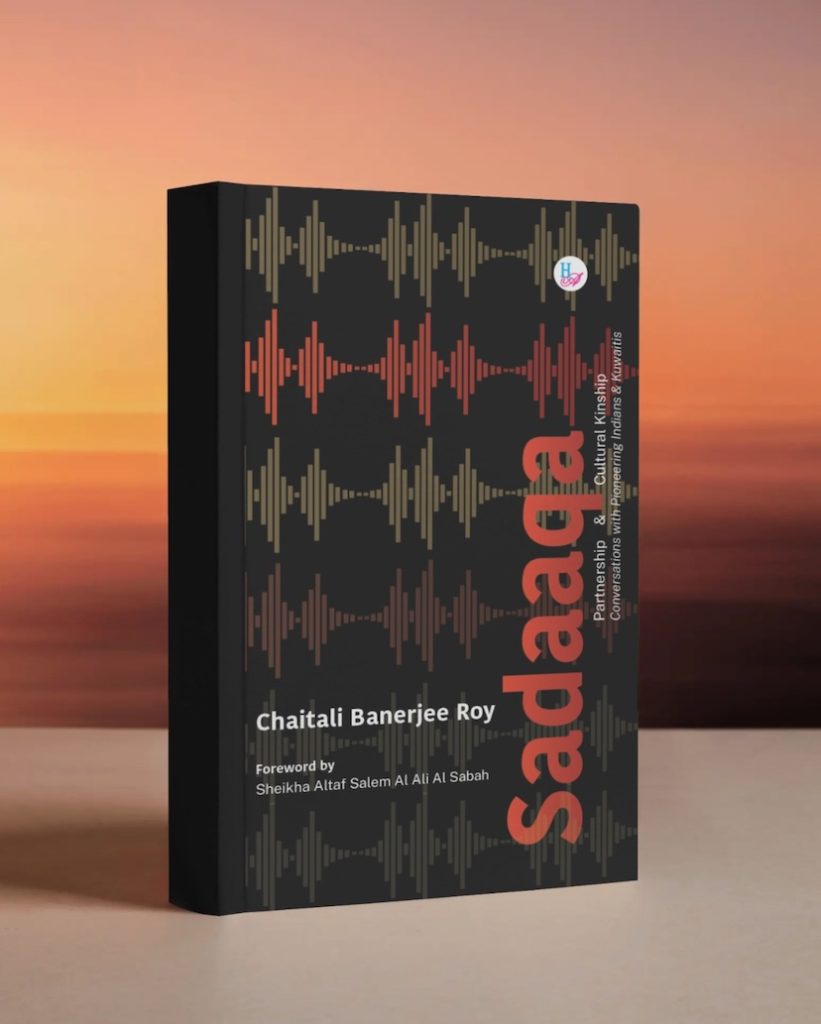
Sadaaqa shines a light on pioneering Indian families who became integral to Kuwait’s social and economic fabric—the Jashanmals, Oberois, Kohlis, Bhasins, Wadhawans, Lambas, and Mathews—while also honoring Kuwaitis who embraced India with equal warmth. Among them are Dr. Lubna Al Qadi, Sheikha Souad Al Sabah, Mubarak Al Rashed, Ahmed Al Sarraf, and the Al Arfaj sisters.
Sadaaqa is based on an audio-visual show on Facebook and YouTube that Chaitali launched in January 2022. The book is based on the stories that she uncovered over her first two seasons. Right now the show is in its fourth season, so there are many more stories to be told. One of the book’s most striking highlights is the story of Sheikha Shaikha Al Sabah, the first Kuwaiti to receive India’s prestigious Padma Shri award, honored for her pioneering role in promoting yoga. Her journey reflects not only personal dedication but also the mutual enrichment of Indo–Kuwaiti cultural exchange.
The foreword, written by H.H. Sheikha Altaf Salem Al Ali Al Sabah, anthropologist and custodian of Kuwait’s heritage crafts, frames the book with historical depth and cultural resonance. For Chaitali Banerjee Roy, Sadaaqa is a natural extension of a career dedicated to storytelling. Beginning as a radio broadcaster in Calcutta more than two decades ago, she has been contributing to the Arab Times since 2001 while also working with Radio Kuwait. Her passion for documenting women’s stories led to her first book, “Women of Kuwait: Turning Tides”, which broke new ground by profiling Kuwaiti women leaders, pioneers, and changemakers.

“I am essentially a storyteller who enjoys connecting the dots and bridging cultures,” she explains. “With Sadaaqa, I wanted to preserve voices that might otherwise be lost, ensuring that future generations understand and celebrate the bonds of friendship that have shaped both nations.”
What emerges from Sadaaqa are stories that go beyond success to reveal grit and survival.
Figures like Kuldeep Singh Lamba, who arrived in Kuwait as a teenager after surviving Partition, built his business from a one-man tyre shop into the Al Mailem Group. Or S.K. Wadhawan, who endured the loss of his mother during Partition and began life in Kuwait at seventeen, living in spartan conditions before founding the Samara Group.
“These pioneers remind us that success is not inherited—it is earned, often against unimaginable odds,” Chaitali reflects. Their resilience, she adds, continues to inspire generations.
Just as powerful are the voices of Kuwaitis whose lives were intertwined with India. Dr. Lubna Al Qadi, who grew up in Bombay, recalls celebrating Diwali with friends and even bumping into the Beatles at the Taj Hotel. Mubarak Al Azmi, dubbed Kuwait’s “Kishore Kumar,” can sing old Bollywood classics with astonishing precision. And Sheikha Shaikha Al Sabah, deeply immersed in yogic philosophy, exemplifies how cultural bridges are built not through passing trends but through authentic absorption.
For Chaitali, the urgency of the project was clear. “I often worried that if these stories were not documented soon, they would vanish forever,” she says. “Oral history is not just conversation; it is lived experience, capturing memory and cultural identity for generations to come.”
By capturing both Indian and Kuwaiti voices, Sadaaqa ensures that the full picture of this friendship is preserved—not just the struggles of Indian migrants, but also the warmth and openness of Kuwaitis who welcomed them.

Sadaaqa also builds on the work Chaitali began with in her first book, which challenged stereotypes about Kuwaiti women. “Despite the huge number of Indian professionals, academics, and entrepreneurs who have shaped Kuwait, many young Kuwaitis still associate Indians mainly with blue-collar jobs. Through this book, I wanted to expand that narrative and highlight resilience, entrepreneurship, and kinship as part of the story.”
Looking ahead, Chaitali hopes to return to her paused project, Daughters of Kuwait, and is also exploring the possibility of adapting Sadaaqa into an audiovisual format.
In the end, Sadaaqa is more than a book. It is a cultural archive, a preservation of voices that might otherwise fade into silence. By weaving together Indian and Kuwaiti narratives, it reminds us that friendship is never one-sided; it thrives in the stories shared, the traditions embraced, and the memories carried across generations.
“Sadaaqa is about resilience, kinship, and the shared human stories that bind us,” Chaitali says. “It is my tribute to the past and my offering to the future.”
For updates, follow Chaitali Banerjee Roy on Instagram @chaitalibroy, Facebook at Chaitali B Roy, or visit her YouTube channel @CHAITALIBROY.