
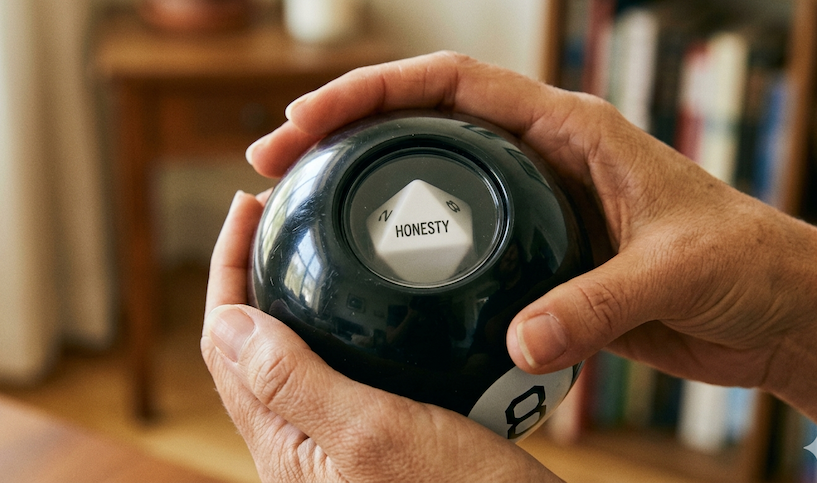
Most people have values. Far fewer have examined them. The difference matters more than it sounds, because unnamed values don’t disappear; they just operate without your input, quietly shaping your choices, your reactions, and the slow accumulation of a life. Naming them is not a self-help exercise. It’s a form of self-governance.
What a value actually is A value is not an aspiration or a personality trait. It is a principle that, when violated, produces a specific and recognizable discomfort. You know you value honesty not because you’ve written it on a vision board, but because dishonesty, in yourself or others, produces a reaction you can’t ignore. James Clear, in Atomic Habits, puts it plainly: every action you take is a vote for the type of person you wish to become. Values are the ballot, not the campaign poster. They are felt before they are named, which is why examining them requires paying attention to what genuinely bothers you, not just what you think should bother you. They are also revealed under pressure. Anyone can claim to value integrity when nothing is at stake. The real test is what you do when it costs you something.
The difference between inherited and chosen values Most of the values operating in your life arrived without your consent. Family, culture, religion, school: each installs a framework before you’re old enough to interrogate it. Some of those values will hold up under examination and remain yours by genuine choice. Others won’t. Viktor Frankl, writing from experience few of us will ever have to imagine, observed in Man’s Search for Meaning that the last of human freedoms is the ability to choose one’s attitude in any given set of circumstances. Choosing your values, rather than simply inheriting them, is an extension of that same freedom. In Kuwait, where family and community carry particular weight, this sorting can feel uncomfortable. It need not mean conflict. It means ownership.
How to identify yours Look at where you spend your time and money without being asked to. Look at what makes you genuinely angry, as opposed to what you think should make you angry. Look at the decisions you’ve made that felt right even when they were costly. Look at the moments you’ve compromised and the particular quality of the discomfort that followed. Your values are already visible in your behavior. The examination just makes them legible. Brené Brown, in Dare to Lead, suggests narrowing your values to two core ones, arguing that when everything is a value, nothing is a priority. A useful exercise is to write down the ten things you care about most, then cut the list to five, then to three. What survives the cuts is usually the truth.
Values as a decision-making tool The practical use of knowing your values is that they function as a filter. When a decision is difficult, it is usually because it involves a conflict between two things you want. When you know your values and their order of priority, the conflict resolves more cleanly. Not painlessly, but clearly. A person who knows they value security over novelty makes a different career decision than one who values the reverse, and neither is wrong. The clarity is the point. As the Stoic philosopher Marcus Aurelius wrote in Meditations, you have power over your mind, not outside events. Values don’t make hard decisions easy. They make them honest, which is the next best thing.
When your life and your values don’t match The most useful signal a value can send is misalignment. A persistent sense that something is off, that a job, a relationship, or a habit doesn’t sit right, is often not a mood but a message. Values ignored don’t go quiet. They tend to get louder, showing up as restlessness, resentment, or a vague dissatisfaction that no external change quite fixes. Cheryl Strayed, in Tiny Beautiful Things, writes about the necessity of asking yourself what you want and then honoring that answer, however inconvenient it turns out to be. Paying attention to that signal is not indulgence. It is navigation. The people who describe their lives as genuinely their own tend not to be the ones who had the most options. They are the ones who learned to read that signal early and take it seriously.
Values in relation to other people Knowing your values also changes how you relate to others. It becomes easier to recognize when a relationship, professional or personal, is asking you to operate against your own grain, and easier to articulate why certain dynamics don’t work for you without framing it as a personal failing on either side. Ralph Waldo Emerson wrote in Self-Reliance that to be yourself in a world that is constantly trying to make you something else is the greatest accomplishment. People who live by a clear internal code are recognizable, even when that code is never stated outright. There is a steadiness to them that has nothing to do with certainty and everything to do with knowing what they’re not willing to trade away.
They are allowed to evolve A value held at twenty-two is not a life sentence. People change, circumstances change, and the principles that once organized your life sometimes need to be renegotiated. The goal is not to find your values once and defend them forever. It is to stay in honest conversation with them, returning periodically to ask whether the architecture still fits the life you’re actually living. As Maya Angelou put it, do the best you can until you know better, then when you know better, do better. The most grounded people are not those with the most rigid value systems. They are the ones who have examined theirs often enough to trust them.