
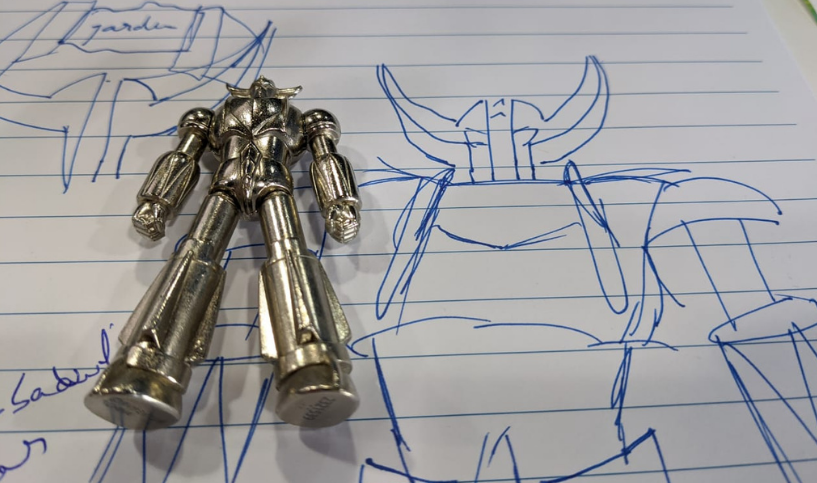
My husband’s wedding trousseau was… interesting. And yes, grooms should absolutely be allowed to carry their well-curated personal possessions too. Here’s to breaking gender boundaries, and, well, to the toys I inherited. Yes, toys. If I’m allowed to call collector’s items that and get away with it, can I? He brought with him figurines of Grendizer from his home in Kuwait to ours in Dubai. They now live on a bookshelf in our bedroom, resting atop his collection of superhero books. The bookshelf is in our bedroom, so we are close, they and we. They are, I must admit, works of art. Sculpted in mean metal, not chipped at any place, and carrying a presence far larger than their miniature size.
“That’s all I could afford,” my husband says, slipping into nostalgia, almost mopiness, about how he could only buy one when he got his first job. Because I know better, I empathize. I don’t remind him that he was a fully grown adult who could have chosen differently. A watch, perhaps? I live in constant vigilance and fear, so I keep reminding him of the loans we have to pay, just in case he is nursing a dream of bringing home another Grendizer (I’ve seen the life-size versions). “The tiny ones speak volumes,” I add, with enthusiasm. The first one and the second one (later) were apparently bought at an action figure and video game parlor in Hawally.
His friends from Kuwait have collections too. I haven’t yet taken this up with their partners. What I do know is this: as boys, it was their show. It was the 1980s. It aired once a week for 30 minutes. It ran in Arabic with no subtitles, and while all of them were studying Arabic in school, they claim that, in any case, the language was not a concern for understanding the essence of what was played. “A robot meets a spaceship,” they say, simplifying their admiration for the childhood hero and adult-age toy. The Grendizer fought the villain of the week in each episode. “He saved the world.” The echo of that belief from the 80s still rings loud enough in the 2000s.
In the 2000s, Grendizer saw a regional resurgence. Its creator, Go Nagai, visited Kuwait in 2009 for a fan meet-and-greet. No points for guessing who stood in those long queues. What followed was a massive, multi-million dollar official franchise revival—spearheaded and heavily sponsored by the Saudi government. In 2022, Saudi Arabia’s Manga Productions (a subsidiary of Crown Prince Mohammed bin Salman’s MiSK Foundation) partnered with the original Japanese rightsholders, Dynamic Planning. The rest, as they say, is history. The humble hero of the 80s now lives in theme parks and makes appearances on stages. My husband picked up another one, miniature again, thankfully, at the Middle East Film & Comic Con in Dubai. “The days of downloading comics from torrents over choppy internet are long gone,” he reminisces.
So what shines the most about Grendizer in the highly commercialized world of 2026? I’d say the sparkle in the eyes of grown men who still can’t get enough of this ‘Middle Eastern’ toy. Because here’s the thing, it wasn’t even set in Kuwait. Or the Middle East. Maybe Japan. “It looked like the US,” says my husband. So then, what was it about Grendizer that played in Arabic and set in another land that got them all hooked? The answers could run deeper, but this is the one I like: “We were just a bunch of boys who were happy to see Grendizer fight and win.” Childhood, after all, is and should be that simple.
It’s 2026, and I have fully embraced Grendizer in all its avatars. I even spotted a keychain recently. And I thought if women can flaunt Labubu dolls on their bags, why can’t men? If my husband gets the keychain, I’ll allow it, but it won’t be part of our set of home keys. And yes, not long ago, but I did spot a Tissot Grendizer. I could get him something for the anniversary; I can only hope there are enough grown-up fans around to help me crowdfund this one!
Purva Grover is a UAE-based author, journalist, and creative entrepreneur. You can stalk her on Instagram, @purvagr. Backed by a master’s degree in Mass Communication and Literature, she remains stubbornly passionate about anything that begins with Once Upon a Time… Her work stretches beyond print: podcasts, talks, theatrical collaborations as a playwright and stage director, art-led projects, and interdisciplinary storytelling are all part of her creative playground. In 2021, she was awarded the UAE Golden Visa by the Dubai Culture & Arts Authority and recognized under the People of Culture and Art—Writer category as part of the inaugural Class of Creators.