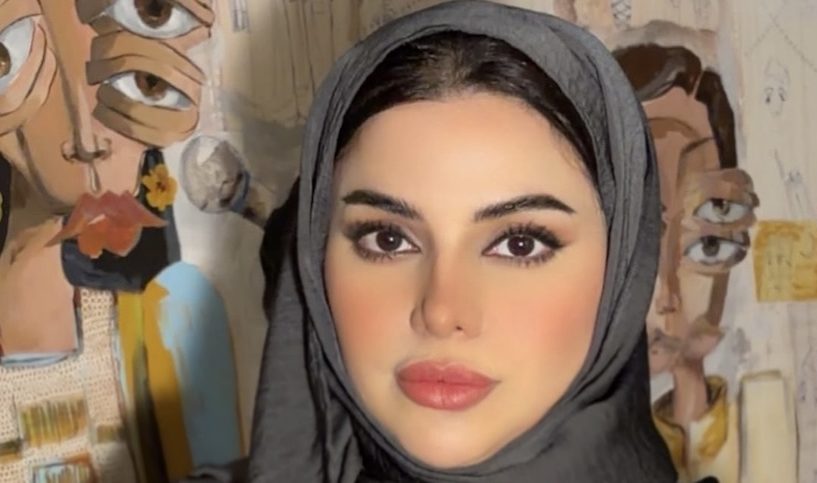
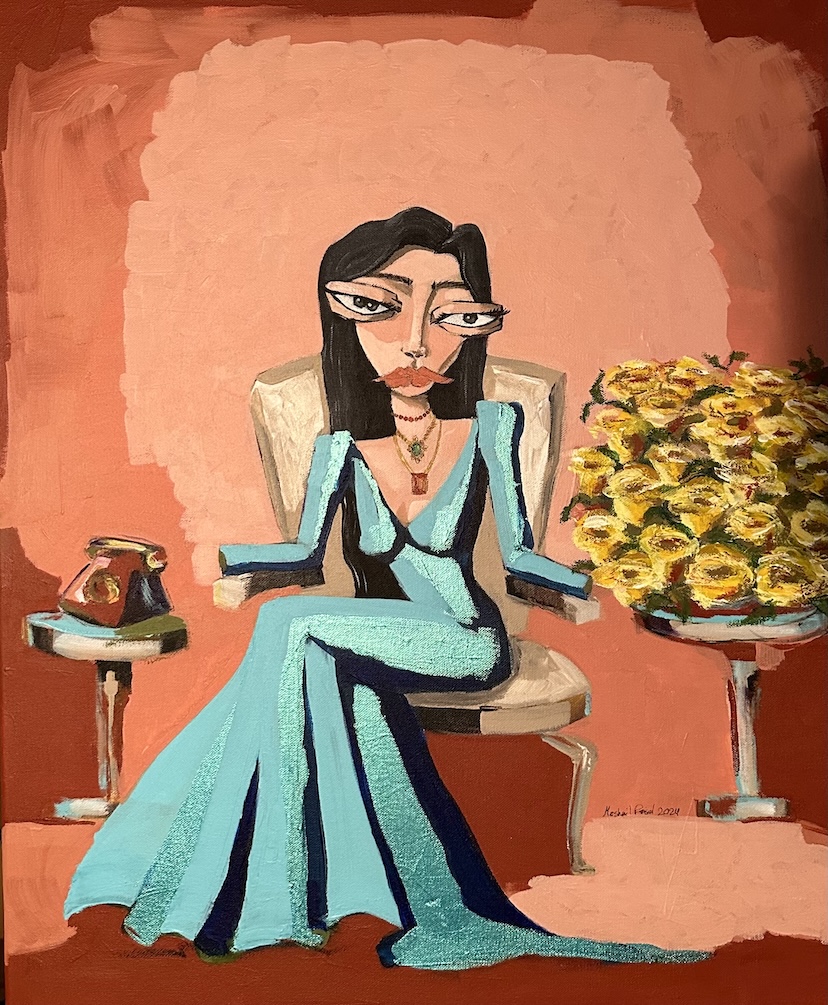
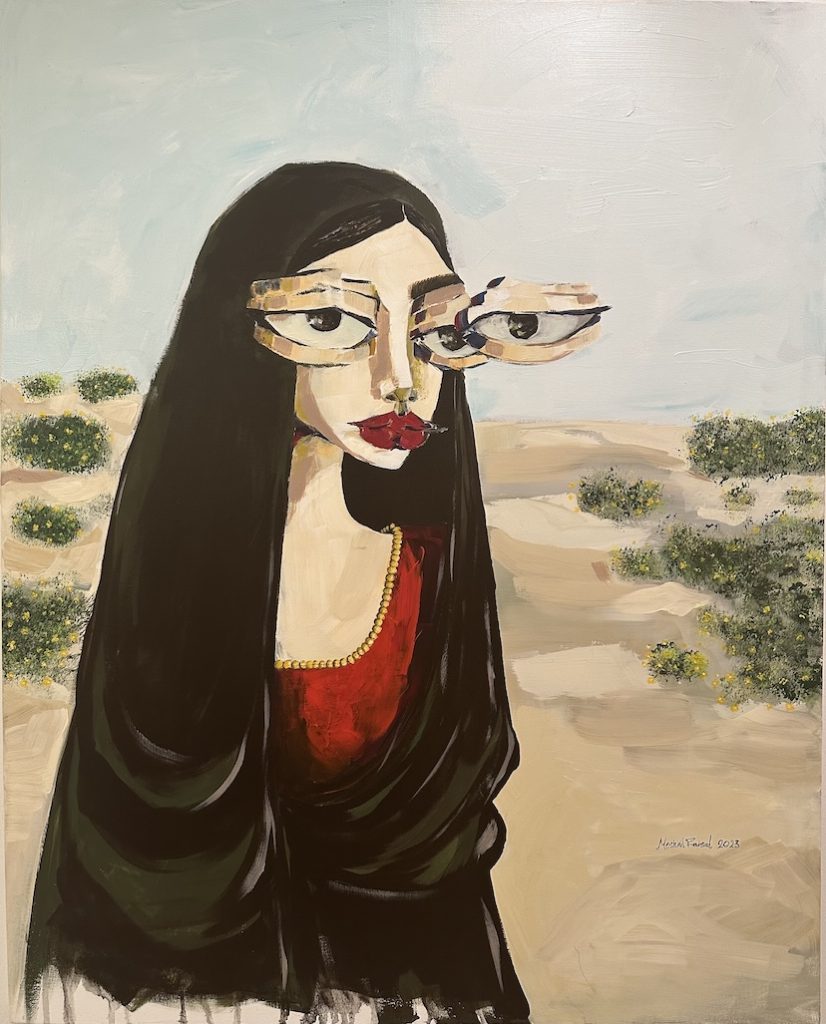
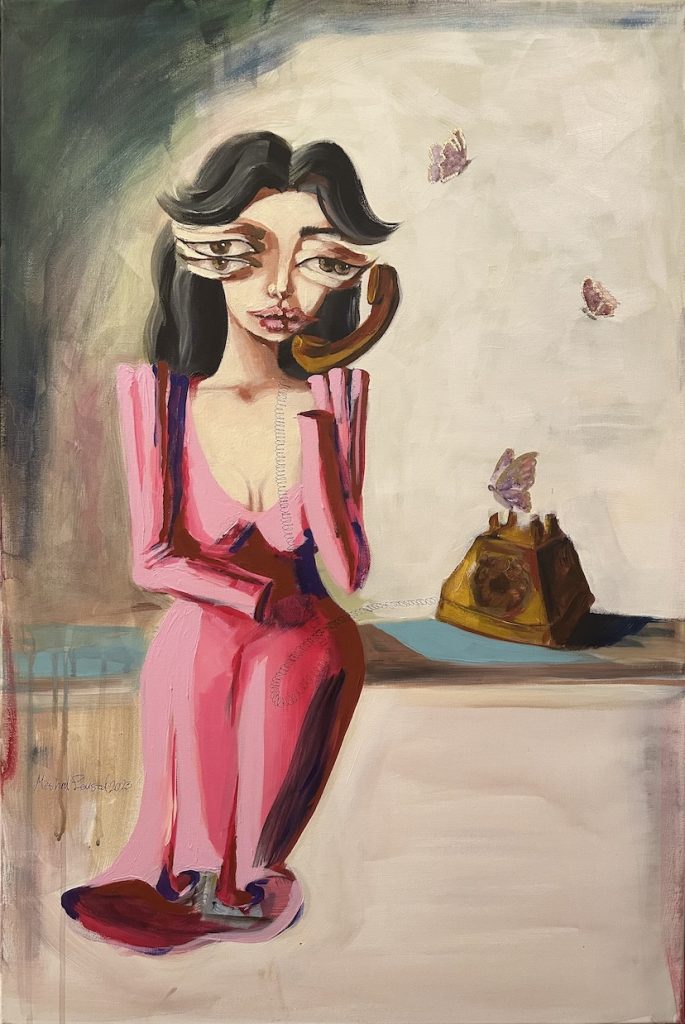
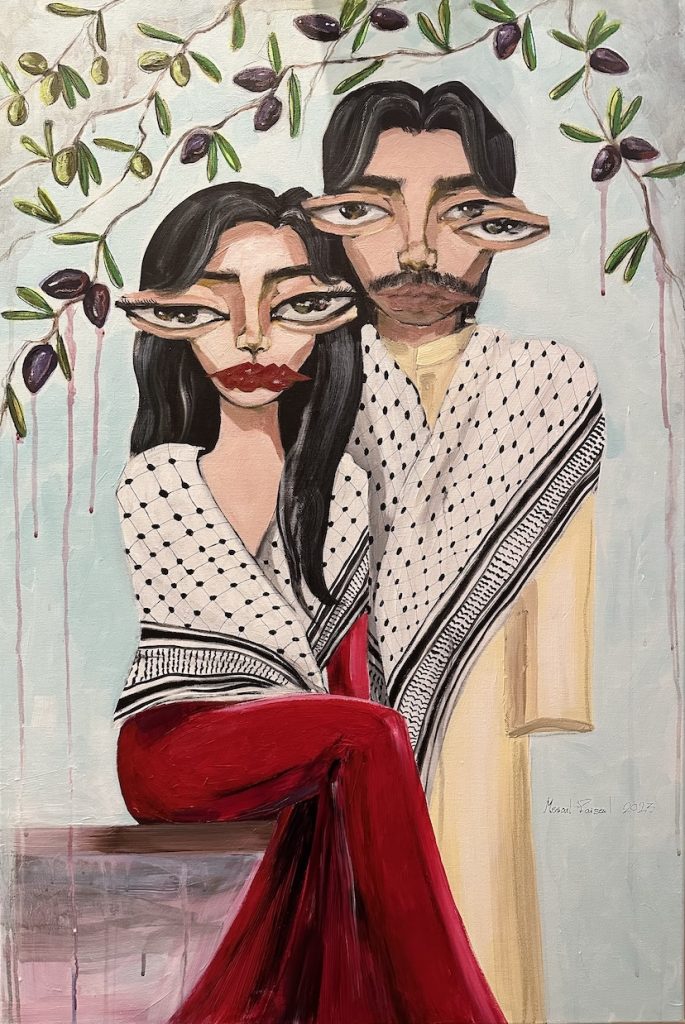
There is something eerie about being looked at by a painting. In Meshail Faisal AlJummah’s work, eyes appear everywhere. They widen, multiply, and wander away from where we expect them to look. Some meet our gaze directly. Others seem preoccupied with something beyond the edge of the canvas. Around them, human bodies stretch beyond anatomical logic, faces fragment, and animals inhabit worlds that feel simultaneously playful and unsettling.
Perhaps the figures are watching us. Perhaps we are watching them. Meshail would rather not decide.
“The moment I give them one meaning, they stop looking in all those different directions,” she says.
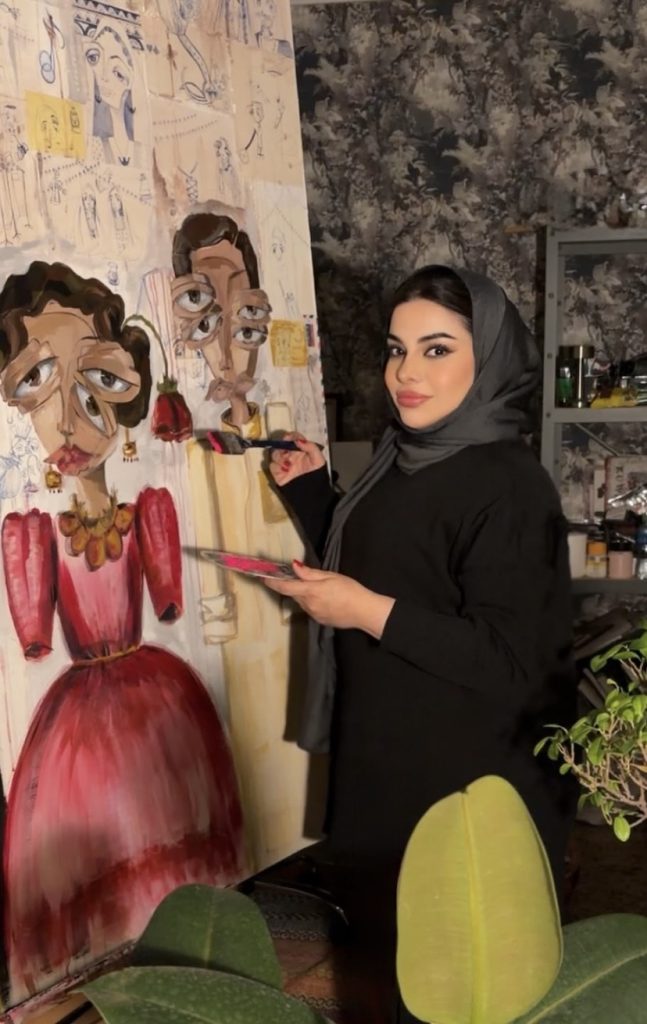
That resistance to certainty sits at the heart of Meshail’s practice. A Kuwaiti visual artist, sculptor and writer, she has spent more than a decade developing a distinctive visual vocabulary, one in which distortion can communicate what realism cannot and a painting does not need to explain itself to be understood.
Art was part of her life long before it became a career. Meshail studied Earth Sciences and Environment at Kuwait University, while pursuing her passion for painting and sculpture. Today, she describes art as “the language through which I felt I could understand and express the world most honestly.”
It is tempting to look at an artist with such a recognizable aesthetic and imagine it was carefully constructed. Meshail says the opposite.
“My visual language developed through repetition, curiosity, and instinct,” she explains. “Certain faces, eyes, distortions, colors, and forms kept returning to my work.”
Over time, those elements became a vocabulary of their own. The enlarged eyes, altered faces and impossible proportions allow her to push the human figure somewhere realism cannot easily go.
“The human figure interests me precisely because it doesn’t have to remain anatomically correct to feel human,” she says. “An enlarged eye, an altered face, or an impossible proportion can communicate a psychological state immediately.”
Beauty With Something Beneath It
Meshail’s paintings occupy an intriguing emotional middle ground. They can be whimsical and tender, but rarely simply pretty. Something feels slightly off. A figure might draw you in at first glance, then another detail shifts the mood entirely.
“I don’t necessarily want someone to look at a painting and immediately decide whether it is beautiful or disturbing,” she says. “I would rather they feel something first and understand it later, or perhaps never fully understand it.”
For Meshail, beauty without tension risks becoming passive. Unease makes us look again. It turns looking into questioning.
That matters in a moment when images are consumed almost instantaneously. Social media has made art extraordinarily accessible, but it has also accustomed us to seeing, absorbing and moving on within seconds. Meshail refuses to paint at that speed.
“A painting should be allowed to reveal itself slowly,” she says. “Sometimes the first thing you notice attracts you, but the second or third thing changes your understanding of the entire image.”
A Story Without an Ending
That invitation to linger extends to narrative. Meshail may begin with a memory, emotion, thought or image, but she does not expect the viewer to arrive at the same story she did.
“I don’t want a painting to function like an explanation,” she says.
Viewers have discovered relationships between figures and meanings in symbols that she never consciously intended. Rather than correcting those interpretations, she welcomes them.
“Once a painting leaves my studio, I think it begins another life. The viewer brings their own memories and experiences to it, and that becomes part of the work.”
Her relationship with storytelling extends beyond the canvas. Meshail created artwork for Mama Hissa’s Mice, Saud Alsanousi’s novel, which required her to enter a world another artist had already constructed through words.
“With literature, there is another voice in the room, the writer’s voice, and I have to find a way for my visual language to meet it without either one overpowering the other,” she explains.
Rather than illustrating a scene literally, she wanted to capture something of the novel’s spirit while keeping the image recognizably her own. The experience also changed the way she approached storytelling in her paintings, showing her how much could exist beyond the visible image.
“Sometimes what you leave outside the painting is as important as what you put inside it.”
It makes sense, then, that if she had not become a visual artist, Meshail believes she would have pursued writing. For her, both disciplines share the same impulse: constructing a world and inviting someone else inside.
Layers of Looking
Even Meshail’s scientific background becomes connected to the way she creates.
“Earth Sciences teaches you to look at surfaces and understand that there are histories underneath them,” she says. “Layers, erosion, transformation, time, structure. These ideas are scientific, but they can also be very poetic.”
Science trained her to observe. Art gave her permission to take those observations somewhere less logical and more intuitive.
She has been doing so since she began exhibiting in 2010, with her work shown across Kuwait and internationally. Looking back, she sees her younger self as an artist searching for a language and trying to understand what genuinely belonged to her.
“Today I know my language better, but the searching hasn’t stopped,” she says. “The difference is that now I’m less interested in finding answers. I’m more interested in finding better questions.”
Those questions are becoming larger in scale. Meshail is increasingly interested in expanding the world of her paintings beyond the canvas through sculpture and immersive works, bringing painting, sculpture, literature and writing together rather than treating them as separate disciplines.
It is easy to imagine the possibilities. What happens when one of those exaggerated eyes no longer looks outward from a canvas, but occupies the same physical space as the viewer? What happens when we can walk through, rather than simply look into, one of Meshail’s worlds?
Perhaps that is where her practice is heading. Not toward answers, but deeper into the uncertainty that has always interested her.
When asked what she hopes visitors take away from an exhibition, Meshail resists prescribing an emotion. Curiosity is welcome. So is discomfort, tenderness or a question they cannot immediately articulate.
What matters is that something remains.
“I like the idea that an image might return to someone’s mind hours or days after they have left the exhibition,” she says. “For me, that lingering memory is more meaningful than immediate understanding.”
Perhaps that is the best way into Meshail Faisal AlJummah’s work. Look once. Look again. Notice what is looking back. And resist the urge to solve it.
TRUTH OR DARE
How would your mother describe you in one word?
Stubborn.
How would you describe your mother in one word?
Home.
What is the most ridiculous question you’ve ever been asked?
“Why don’t you paint something normal?”
What is the most spontaneous thing you’ve ever done?
Following an idea simply because it felt right, without knowing where it would lead me.
What is your theme song?
“ The world we knew “ Frank Sinatra
What word in the English or Arabic language do you wish you had invented?
الخيال— Imagination.
Where would you like to live?
Somewhere old, beautiful and close to nature. Maybe Granada.
What is your dream retirement location?
By the sea, with my family and a studio. I don’t think I’ll ever retire from art.
What is the first famous quote that comes to your mind?
“Everything you can imagine is real.” — Picasso.
Which animal best describes your perfect partner, be it in business, or in life?
A horse. Strong, loyal and free.
Do you miss anything from your childhood and if so, what is it?
The freedom to imagine without questioning everything.
If you could change your name, to what would you change it?
I wouldn’t. Meshail feels like me.
How would you describe your handshake, in one word?
Confident.
What is the toughest part of your character?
I rarely give up, even when I probably should.
Who is your favorite historical figure?
Leonardo da Vinci. I admire his endless curiosity.
What in the world do you least desire?
A life without curiosity.
What do you think is lacking in the world, which, if there were more of it, would make the world a better place?
Empathy. We need to understand each other more.
Why do you think most people who do, like you?
Maybe because I’m simply myself with them.
Finish this sentence: “Happiness is…”
Happiness is knowing the people I love are safe, and having something to look forward to.
Follow Meshail’s work on Instagram @meshailalfaisal.